Modeling in Business: From Business Models to Executable Processes
By Nikhil Gupta
Modeling in Business: From Business Models to Executable Processes
Every organization, whether it sells directly to individual end-users as a B2C company or operates as a B2B company selling products or services directly to other businesses, relies on some form of structured thinking about how it creates and delivers value. That structured thinking is modeling in business - and getting it right can mean the difference between scaling smoothly and firefighting every quarter.
Introduction to Modeling in Business
Business modeling is the practice of creating abstract representations of a company's operations. It spans two distinct but connected domains. A business model describes how the company makes money and delivers value - the "why and what." A process model shows how activities are executed day to day - the "how." Together, they form a foundation for decision-making based on structured analysis, and they provide a single source of truth for cross-functional teams in businesses of any size.
The idea of formalizing business models isn't new. The term appeared as early as the 1800s, but the modern chapter started when Alexander Osterwalder published his PhD thesis on business model ontology in 2004, later popularized in Business Model Generation (2010). That work gave managers a visual, iterative canvas to replace old school 60-page strategy documents. Since around 2020, the world has shifted again: AI-driven tools now convert plain-language descriptions into executable process diagrams, opening a new chapter in how companies define and operationalize strategies.
Why does this matter right now? Rapid digitalization, AI adoption, and regulatory pressure from subjects like GDPR, SOX, and HIPAA all demand that processes be documented, governed, and continuously improved. Process mapping visualizes business processes for better understanding and supports strategic planning and decision-making in organizations. In fact, companies that treat modeling as a living capability rather than a static exercise consistently outperform those that don't.
This is where Vevos fits in. Vevos enables users to go from a plain-language description of how work gets done straight to professional BPMN 2.0 process maps, generate documentation, collaborate with stakeholders, and automate execution via specialized AI agents - all without needing a developer on call.

Business Models: The Big Picture of How a Company Creates Value
A business model defines how a company creates, delivers, and captures value. Different business models shape capital allocation, supply chains, and customer relationships in fundamentally different ways. Consider these common patterns:
Subscription SaaS (e.g., Adobe Creative Cloud): Subscription models demand high customer retention and predictability of revenue. Adobe wanted to shift from one-off perpetual licenses to recurring streams and succeeded by moving to the cloud.
Marketplace (e.g., Airbnb, Uber): Marketplace business models require balancing supply and demand growth simultaneously. The platform itself rarely owns inventory.
Freemium (e.g., Dropbox): Freemium models focus on user acquisition and conversion strategies, betting that a small percentage of free users will upgrade.
Usage-based pricing (e.g., AWS): Customers pay for what they consume, aligning cost with value delivered.
Core types of business models include financial modeling and operational modeling - each applicable to different strategic questions. Capital allocation models forecast returns for investment decisions, while operational models help organizations evaluate process efficiency and effectiveness.
Netflix provides a useful case study. The company started with DVD-by-mail, a product sale model, then shifted to streaming subscription. That business model innovation changed its cost structure, customer relationships, and growth trajectory entirely. The lesson: business models need revisiting during strategic planning cycles - annually, or whenever you enter new markets - rather than treated as static documents.
Business Model Frameworks: From Canvas to Portfolio
The Business Model Canvas remains at the center of how teams articulate strategies visually. Its nine blocks - customer segments, value propositions, channels, customer relationships, revenue streams, key resources, key activities, key partnerships, and cost structure - give a clear articulation of how a business works. But it isn't the only framework available:
Business Model Canvas: Best for broad understanding or redesign. Applicable across industry domains and company sizes.
Lean Canvas: Tailored for entrepreneurship and startups - replaces some blocks with problem, solution, metrics, and unfair advantage.
Ecosystem / Platform Canvas: For multi-sided platforms where network effects and producer/consumer segments matter.
Business modeling can clarify strategic alignment and product-market fit. Teams can sketch multiple alternative models side by side and compare trade-offs as a portfolio. For example, a mid-sized manufacturing firm might model a direct-to-consumer e-commerce approach alongside its existing distributor-based model. The comparison reveals differences in channel control, logistics cost, and customer relationships - giving managers the data to decide before committing resources.
These frameworks complement rather than replace traditional business plans. They bring speed and visual clarity; the plan adds financial detail and operational rigor. Business modeling allows organizations to simulate real-world scenarios before committing resources, which is the whole purpose of the exercise.
Business Model Innovations and Strategic Planning
Business model innovations are deliberate changes to how value is created, delivered, or captured. Moving from one-off consulting to recurring SaaS, adding outcome-based pricing, or pivoting from a pipeline to a platform - these are all examples of companies choosing to innovate at the model level rather than just the product level.
Strategic modeling simulates competitive dynamics and customer demand shifts, making innovation less of a gamble. Consider these past examples:
Apple: Shifted from selling hardware to building an ecosystem (iPhone + App Store + services), creating recurring service revenue that now rivals the product business.
Rolls-Royce "Power by the Hour": Instead of selling jet engines outright, Rolls-Royce charges airlines per engine-hour flown - an exploitation of outcome-based pricing that aligned incentives across the value chain.
Amazon Web Services: Monetized spare infrastructure, turning internal capacity into a wholesale cloud product - an approach that opened entirely new opportunities.
Scenario analysis allows executives to understand impact from variable changes. Risk quantification models help organizations assess and mitigate potential risks before a march toward full commitment. Financial modeling projects a company's future income statements and cash flows, while forecasting models estimate future outcomes using historical data. Together, these concepts reduce risk by letting you test unit economics, customer lifetime value, and payback period in a model before the real world intervenes.
Vevos helps here by taking a chosen business model concept and translating it into executable process models and workflows - bridging the gap between the strategy a team discussed in a planning session and the activities people actually perform.
From Business Models to Business Plans
The relationship between a business model and business plans is sequential: model first, then plan. The model is the architecture; the plan is the operational roadmap with budgets, milestones, and risk mitigation.
A modern business plan in 2026 should cover:
Market analysis (TAM, competitive landscape, regulatory context)
Strategic positioning and go-to-market
Operations plan with process flows and resource allocation
Technology and AI strategy
Risk, compliance, and governance
Financials: revenue projections, scenario sensitivities, return on investment
Operational modeling maps workflows and resource allocations to optimize efficiency, and these details feed directly into the plan. Consider a SaaS startup preparing for a Series A: the team sketches several revenue models on a canvas, maps key processes (customer onboarding, billing, support), estimates cost per process, and uses those numbers to project burn rate and margin. Completing the cycle from model to plan shortens what used to take months into weeks - because the underlying logic has already been validated in a structured form.
Process Modeling: Turning Strategy into BPMN and Workflows
Process modeling is the discipline of visually documenting how work flows across departments, systems, and people. It bridges the gap between a conceptual business model and the daily reality of delivering on a value proposition.
BPMN 2.0 is the latest version of the BPMN standard, and BPMN diagrams standardize business process modeling with a shared notation for activities, gateways, events, and message flows. BPMN diagrams help visualize complex business processes clearly and can represent both high-level and detailed process flows. They facilitate communication among stakeholders in a project - bridging the gap between operations leaders and IT teams with ease.
Processes that should be modeled include:
Lead-to-cash (sales through billing)
Procure-to-pay
Employee onboarding
Customer support escalation
Compliance approval workflows
Process mapping enhances communication among team members, helps identify inefficiencies and areas for improvement, and effective process mapping can lead to increased operational efficiency. These aren't abstract benefits - they translate directly into cost savings and better performance.
AI-Powered Modeling and Automation (Vevos Perspective)
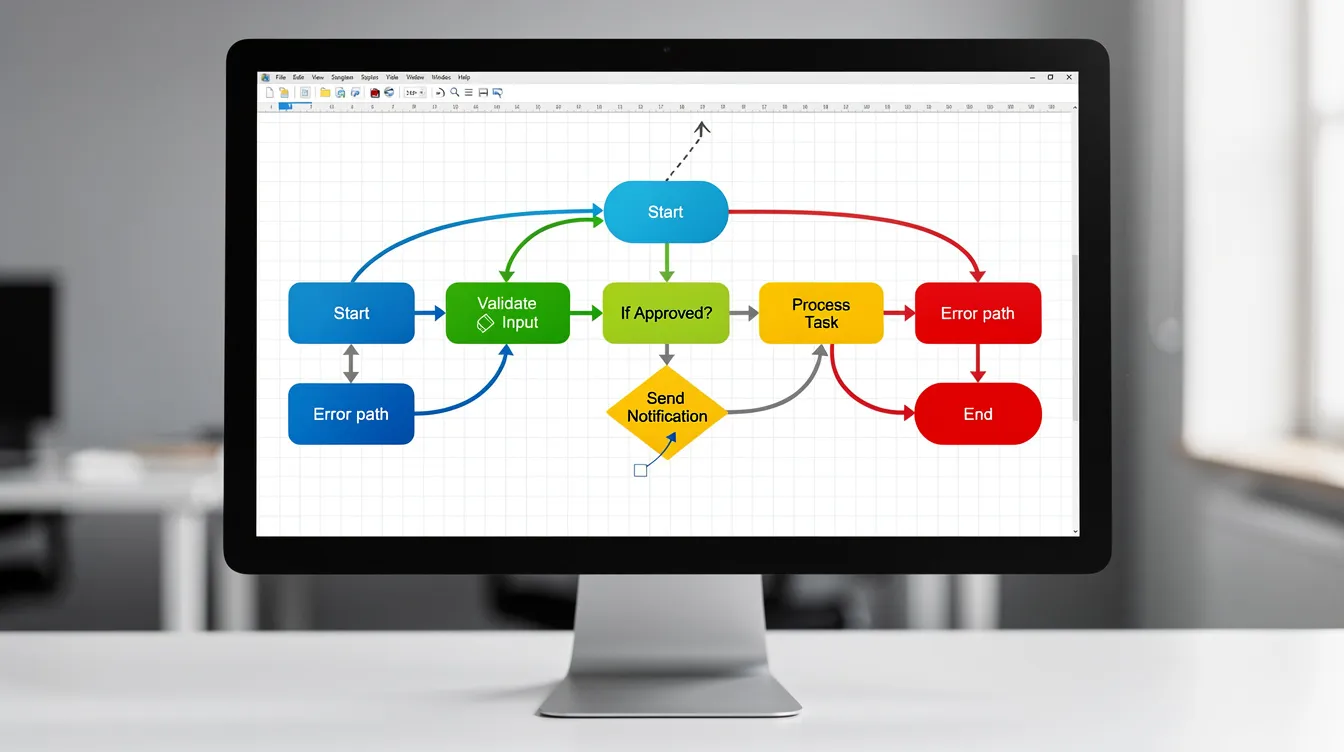
Since around 2020, AI has transformed business process management in ways that would have seemed a bit far-fetched a year or two earlier. AI tools can automate business process documentation, and AI can convert plain-language descriptions into process maps. Natural language input simplifies process modeling for non-technical users and allows for faster documentation of business processes. Natural language input can also enhance collaboration among team members and reduce reliance on technical expertise in BPM - which matters a lot when your process owners aren't developers.
Research published in a 2026 journal article on Business & Information Systems Engineering presented BPMNGen, a conversational framework using LLMs to generate BPMN models from text. SAP Signavio's text-to-process feature claims roughly a 50% reduction in modeling time. AI can generate professional documentation without technical expertise, and AI documentation tools enhance collaboration among team members.
With Vevos, the workflow looks like this: a user types a narrative description of a process - say, "How do we handle loan approvals for small business customers?" - and the platform generates a compliant BPMN 2.0 diagram, SOP-style documentation, and sets up automation via specialized AI agents (Conductor) that orchestrate tasks across systems. Multi-agent orchestration means different agents handle data validation, notification sending, and decision support within a single modeled workflow.
Process discovery identifies and analyzes business workflows, helps organizations understand their operational efficiency, can reveal bottlenecks in workflows, and utilizes data mining techniques to map processes. In addition, workflow automation reduces manual tasks by 50% on average, organizations using workflow automation report 30% faster project completion, and automating workflows can save companies up to 20% in operational costs. These numbers bring modeling out of the "nice to have" category and into the "strategic imperative" column.
Collaboration, Governance, and Compliance in Business Modeling
Business models and process models span multiple functions - finance, operations, IT, compliance, sales - and often multiple geographies. Collaboration is not optional. Shared platforms like Vevos enable comments, version control, approvals, and role-based access so process owners and stakeholders can work together without stepping on each other's work.
Process governance ensures compliance with organizational standards. Effective process governance improves operational efficiency and accountability, and a strong process governance structure enhances decision-making processes. Process governance frameworks help manage risks in business operations by defining who owns each process, how changes are requested and approved, and how audit trails are maintained. Process discovery enhances compliance and governance efforts by surfacing what's actually happening versus what's documented.
On the compliance front, enterprise compliance ensures adherence to regulations and standards. Non-compliance can lead to significant financial penalties for businesses, while effective compliance programs enhance organizational reputation and trust. Compliance frameworks help mitigate risks in business operations - whether you're mapping GDPR data subject rights workflows, SOX controls in order-to-cash, or an ISO 9001 quality program. Regular audits are essential for maintaining enterprise compliance, and models provided as evidence during those audits are far more convincing than informal documentation.
Robust governance transforms models from static diagrams into living assets that guide daily operations and risk management across every area of the business.
Using Modeling to Drive Continuous Improvement
Organizations can use models as a baseline for measuring performance by attaching KPIs - cycle time, error rate, cost per transaction, NPS - to specific activities and subprocesses. This is where models earn their keep over time.
Feedback loops are important. Operational data from automated workflows and process mining tools can reveal that, for example, a customer support process modeled in 2025 has long resolution times at a particular approval step. By 2026, the team redesigns that step - removing a redundant approval - and cuts cycle time significantly. Literature from tools like Celonis and Signavio often cites improvements of 30–50% cycle time reduction after process mining and automation.
AI platforms like Vevos can suggest optimizations: parallelizing tasks, removing redundant approvals, adding automated checks. They can simulate impact before changes go live, letting you learn what works without disrupting production.
Modeling isn't a one-off project you complete and file away. It's an ongoing capability that compounds in value every year you invest in it.
Getting Started with Modeling in Your Business
Here's a practical approach to develop your modeling capability:
Choose a target area: Pick a critical process - order fulfillment, customer onboarding, procure-to-pay - where inefficiency is visible and the cost of failure is real.
Capture the current state: Use natural language. Interview process owners, gather documentation, take meeting notes.
Generate an initial model: Use an AI-powered tool to create a BPMN diagram from your description.
Validate with stakeholders: Map roles, exception handling, edge cases, regulatory touchpoints. This is where you define things precisely.
Connect to systems: Identify where workflow automation plugs in - CRM, ERP, notification tools.
Automate low-risk segments first: Simple paths, non-critical approvals. Build confidence.
Scale and iterate: Expand to adjacent processes. Build a library of reusable patterns.
Start from your existing business model. Identify the most critical value streams that support your core value proposition and revenue, and model the end-to-end processes behind them. Small pilots - say, modeling and automating a single approval workflow in Q1 2026 - build internal champions and prove the return on investment before you scale.
Centralizing your models in one platform ensures they become a strategic asset for future business model changes and strategic planning cycles. You can download templates, open them for collaboration, and manage versions all in one place.
If you wanted to explore what this looks like in practice, Vevos is open for you to try with a single workflow. Pick one process, model it, and see what surfaces. The things you learn in that first pilot will shape how you approach every process that follows.

Related blog posts
- BPMS Free: How to Start Business Process Management Without Paying a Cent — BPMS Free: How to Start Business Process Management Without Paying a Cent
- BPMN Example: From Simple Hello World to Real-World Process Diagram — BPMN Example: From Simple Hello World to Real-World Process Diagram
- Business Process Notation Symbols: A Practical Guide to BPMN Diagrams — Business Process Notation Symbols: A Practical Guide to BPMN Diagrams